
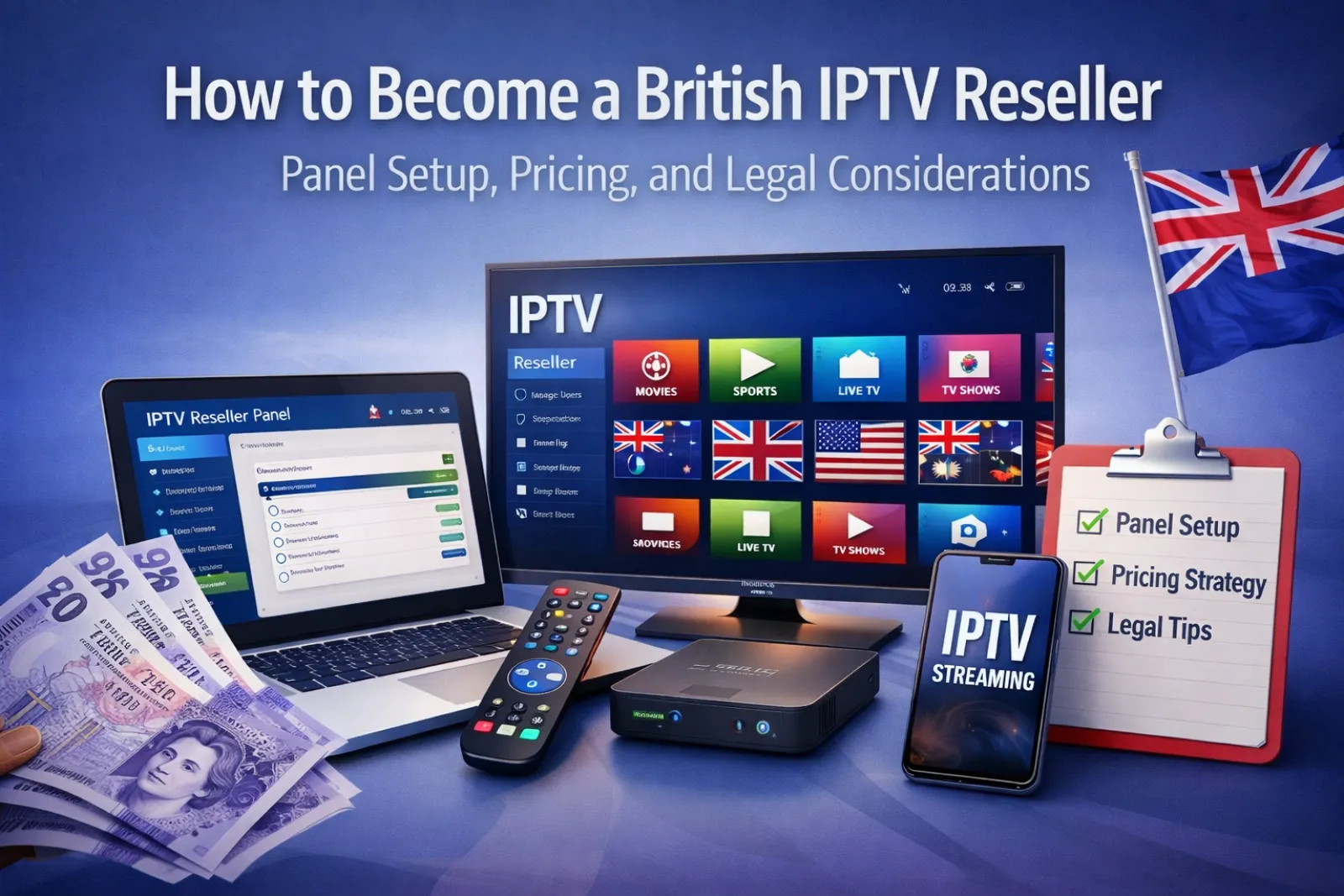
How to Become a British IPTV Reseller: Panel Setup, Pricing, and Legal Considerations
Read Time:14 Minute, 22 Second
Marcus had been driving for a delivery platform for two years. Not because he loved it. Because the flexibility suited him while he figured out what came next.
What came next turned out to be selling streaming subscriptions from his kitchen table in Wolverhampton. A mate had mentioned it casually over a pint, the way you mention something you half-expect the other person to dismiss. Marcus did not dismiss it. He spent a fortnight researching, spent a few hundred pounds on his first reseller credit package, and within 90 days had replaced his delivery income without leaving the house.
He is not unique. Across the UK, a quiet but growing number of people are building legitimate IPTV reseller businesses, some as side income, some as their primary operation. The model suits the British digital landscape particularly well, and the infrastructure to support it has matured significantly over the past several years.
If you are considering becoming an IPTV reseller in the UK, this article covers the three things that actually matter: how to set up your panel properly, how to price for sustainable margins, and how to think about the legal landscape before you start. Most guides skip at least one of those. This one does not.
Table of Contents
- What IPTV Reselling Actually Is
- Why It Works as a Business Model in the UK
- What You Need to Get Started
- Mistakes That Kill New Resellers
- How to Pick a Reliable Provider
- Scaling Beyond Your First 10 Customers
- FAQs

What IPTV Reselling Actually Is
Stripped of the jargon, it is straightforward. You purchase streaming access in bulk from a middleware provider. That provider operates the servers, manages the content delivery infrastructure, and maintains the technical backbone. You access their system through a reseller panel: a web-based dashboard where you create and manage individual subscriber accounts, set your own pricing, and track your credit balance.
When a customer subscribes through you, you create their account in your panel, send them their login details, and they connect through their preferred device. You never touch the technical infrastructure directly. Your job is entirely on the business side: customer acquisition, account management, pricing strategy, and customer service.
The IPTV reseller business model has its deepest roots in the UK market. The combination of high broadband penetration, a tech-comfortable consumer base, and early provider competition produced better panel tooling and more sophisticated reseller infrastructure here than in most comparable markets globally. That history is an advantage for anyone entering the space now: the learning has already been done, the tools are mature, and the operational playbook exists.
Pro Tip: When people ask what you do, you are running a digital subscription business. That is accurate, professionally framed, and requires no further explanation. How you describe your business affects how seriously prospective customers take it, and how seriously you take it yourself.
Why It Works as a Business Model in the UK
The demand side in the UK is consistent. British consumers are accustomed to paying for monthly streaming subscriptions and are comfortable managing them digitally. The market expectation around subscription pricing, payment methods, and service quality is well-established, which means your customers arrive with realistic expectations rather than requiring extensive education.
The supply side is where the model generates its margins. Reseller credits are priced at wholesale rates. The gap between your cost per subscription line and what a UK consumer will comfortably pay for a monthly subscription is where your business profit lives.
Here is what the numbers look like in practice:
Monthly Profit=(Active Subscriptions×Price Per Line)−Panel Cost−Provider Cost\text{Monthly Profit} = (\text{Active Subscriptions} \times \text{Price Per Line}) – \text{Panel Cost} – \text{Provider Cost}Monthly Profit=(Active Subscriptions×Price Per Line)−Panel Cost−Provider Cost
At 70 active subscribers paying £12 per month each, with a provider cost of £4 per line and a panel fee of £20 monthly, net profit sits at approximately £540. Scale to 180 subscribers on the same model and you are looking at over £1,400 per month. These are realistic figures from mid-sized UK reseller operations, not optimistic projections designed to sell you something.
The scalability is genuine because the marginal cost of each new customer is limited to the credit itself. No additional staff. No physical logistics. No incremental overhead beyond the subscription credit.
Uptime is where margin risk lives on the provider side. A provider operating at 98 percent uptime delivers approximately 175 hours of downtime annually. At 97 percent, that rises to over 260 hours. British consumers are not especially forgiving of streaming outages, and refund requests accumulate quickly when downtime is frequent or prolonged. Choosing a provider on price alone, without scrutinising their uptime record, is one of the most reliably costly mistakes a new UK reseller can make.
Pro Tip: Track your own refund rate from month one. If more than 5 percent of your subscribers are requesting refunds in any given month, that is a signal about your provider’s reliability, not just about individual unhappy customers. Act on the pattern rather than treating each request in isolation.
What You Need to Get Started
The barrier to entry for becoming an IPTV reseller in the UK is lower than almost any comparable digital business model. That is both the opportunity and the warning. Low barriers attract underprepared operators, and their poor customer experiences create problems for the category overall. Enter the market prepared.
A properly secured reseller panel. This is your operational foundation. It must enforce HTTPS on all admin access without exception. Two-factor authentication should be available and enabled on your account from day one. The panel interface should allow you to set custom pricing tiers, manage subscription renewals, monitor active connections, and generate basic usage reporting. Do not compromise on these fundamentals to save a few pounds monthly.
A dedicated business email address. Not your personal Gmail. A separate address used exclusively for your panel login and provider communications. This reduces your phishing exposure and maintains a clean separation between your business operations and personal digital footprint.
A payment processing solution. UK consumers expect card payment options. Stripe is widely used among British resellers for its straightforward setup and professional payment pages. PayPal remains common. For customers who prefer bank transfer, a dedicated business bank account keeps those transactions clearly separated from personal finances.
A simple but professional storefront. You do not need a sophisticated website to start. A clean, clearly written page explaining what you offer, what it costs, and how to get in touch is sufficient for the first 20 to 30 customers. Upgrade the presentation as revenue justifies it.
For UK resellers in the early research phase who want to understand the range of British IPTV subscription options available to end customers before deciding how to position their own offering, British IPTV provides a useful reference point for how established operators in this market present their services and what customer expectations look like at the retail level.
Pro Tip: Before you take your first paying customer, test your panel end-to-end from the perspective of the customer. Create a test account, connect from a smart TV, an Android box, a phone, and a laptop. Note every point of friction. Fix it before someone is paying you and frustrated at 10 PM on a Saturday.
Mistakes That Kill New Resellers
I have spoken with enough UK resellers who have been through the hard lessons that I can tell you with confidence: the failure patterns are consistent, predictable, and almost entirely avoidable.
Choosing a provider based on wholesale credit price alone. The cheapest credits in the market are almost always subsidised by underinvestment in server capacity, redundancy, or support responsiveness. You discover which corner was cut the first time your customers message you on a Friday evening to report they cannot connect. The provider you saved £2 per line with is now unreachable and your customers are asking for refunds.
No customer communication process during outages. Downtime happens with every provider. The resellers who lose customers permanently over it are the ones who go quiet. A brief, honest update acknowledging the issue and providing a realistic resolution estimate costs nothing and retains most of the goodwill that the outage temporarily damages. Silence is the real customer killer.
Misunderstanding the legal landscape. This is the conversation most IPTV guides avoid and it is the one that matters most for British resellers specifically. The legal position of IPTV reselling in the UK is not as simple as it is sometimes presented. The content being delivered through your provider may or may not be properly licenced. If it is not, distributing it exposes you to potential legal risk regardless of your technical role in the process. This is not a reason to avoid the business. It is a reason to ask the right questions of any provider before committing: what is their licencing position, and can they document it? A legitimate provider operating within proper commercial arrangements will have clear answers. One who deflects the question is telling you something important.
Over-purchasing credits before validating your provider. Reseller credits are a sunk cost the moment they are purchased. New resellers who load up on credits from an unvalidated provider to benefit from volume pricing frequently discover the provider’s limitations at the worst possible time. Buy conservatively at first, validate performance across several weeks and different usage patterns, then scale with evidence.
Skipping business registration because it feels premature. If you are generating recurring income in the UK, HMRC has an expectation of that being declared. Running a subscription business through personal bank accounts with no formal registration is not a sustainable position. Register as a sole trader or limited company early. The administrative cost is minimal and the alternative is a problem that compounds quietly until it is not quiet anymore.
How to Pick a Reliable Provider
This is the decision that determines the quality of everything that follows. Your churn rate, your support burden, your refund exposure, and your long-term reputation with customers all flow from the quality of your provider relationship.
Ask these questions directly, before you commit a single credit purchase:
Does the panel enforce HTTPS across all admin and API access? What is the documented uptime SLA and what happens contractually when it is breached? What is the process for verifying reseller identity before any credential change is processed on an account? How frequently is the panel software updated? Is there a dedicated reseller support channel with defined response time commitments?
Pay attention to how the answers are delivered, not just what they say. A provider who can answer those questions clearly, specifically, and without hesitation has thought about these issues. A provider who gives vague answers or redirects the conversation has not.
In my assessment of UK-facing panel providers, the operations with the longest market tenure tend to have the most reliable answers to these questions, not because longevity guarantees quality, but because the British market has been running long enough to have sorted the serious operators from the opportunistic ones through attrition. The team at British IPTV Reseller Panels has been in the UK reseller market long enough to have built their infrastructure around the failure modes that newer providers are still encountering for the first time. For resellers wanting British-standard panel infrastructure with the operational history to back up the claims, this is a provider worth evaluating seriously.
Pro Tip: Ask your prospective provider for their most recent incident: what went wrong, when, how long the resolution took, and what process change followed it. Providers who have dealt with real failures and learned from them are operationally more trustworthy than providers with no incident history, because the latter simply means the test has not come yet.
Scaling Beyond Your First 10 Customers
Getting to ten customers is validation. Moving past them requires a shift in how you operate rather than just how many customers you have.
At ten subscribers, manual management is appropriate. You are learning what questions your customers ask, what setup issues they encounter, what their usage patterns look like, and what makes them renew without being chased. That knowledge is worth more than the revenue at this stage.
Past 30 to 40 subscribers, the manual approach creates a ceiling. Automate renewal reminders. If your panel supports it, integrate automated provisioning with your payment system so that successful payments trigger account creation or renewal without your manual involvement. The time you recover from repetitive administration compounds into meaningful additional capacity for customer acquisition.
Build a referral programme before you think you need one. The economics of word-of-mouth customer acquisition in this business are exceptional. A satisfied subscriber in a WhatsApp group, a workplace, or a neighbourhood can generate five to ten new customers from a single recommendation. A small credit discount or renewal extension for successful referrals costs you almost nothing and consistently outperforms paid acquisition channels at small to medium scale.
Consider your business structure as you grow. At 50 subscribers generating meaningful monthly income, the question of limited company registration becomes financially relevant, not just legally sensible. Corporation tax rates, VAT thresholds, and the ability to separate personal and business liability are all factors worth reviewing with an accountant who understands digital subscription businesses.
The British IPTV reseller market rewards operators who treat the business with the same seriousness as any other subscription service business. The customers expect reliability, honest communication, and competent support. Deliver those consistently and the retention rates take care of your growth.
FAQs
Is becoming an IPTV reseller legal in the UK? The legal position depends significantly on the licencing arrangements of the provider you work with. Reselling properly licenced streaming content through legitimate commercial agreements is a legal business activity. Distributing unlicenced content, even as an intermediary, creates legal exposure under UK copyright law. The Intellectual Property Office and OFCOM both take enforcement in this area seriously. The correct approach is to ask your provider directly about their licencing position and to treat any provider who cannot give a clear answer as a material risk to your business. This is not a reason to avoid the model. It is a reason to vet providers properly before committing.
Do I need to register a business to become an IPTV reseller? If you are generating recurring income in the UK, HMRC requires that income to be declared regardless of whether you have formally registered a business. Operating as a sole trader is the simplest structure and can be registered online with HMRC in under 30 minutes. A limited company provides additional liability protection and may offer tax advantages at higher income levels. Consult an accountant before deciding which structure is appropriate for your situation.
How much can I realistically earn as a British IPTV reseller? This depends entirely on your subscriber count, your pricing, and your provider costs. At 80 active subscribers paying £12 per month with a provider cost of £4 per line, net monthly income before tax is approximately £620. At 200 subscribers on the same model, it is approximately £1,580. These are realistic mid-range figures. Some operators do significantly more. Many do less because they underestimate the importance of provider reliability and customer retention.
What devices do UK IPTV customers typically use? Smart TVs running Android TV or Samsung Tizen are the most common. Android set-top boxes are widely used among more technically comfortable customers. Smartphones and tablets account for a meaningful share of viewing, particularly for sports. Amazon Fire TV sticks are common and worth ensuring your subscription type is compatible with. Test your panel’s compatibility across all of these before taking paying customers.
How do I handle customer support as my subscriber base grows? A well-written onboarding guide covering device setup for the four or five most common device types your customers use eliminates the majority of first-week support contact before it happens. Beyond that, honest and timely communication during any provider outage retains most of the goodwill that downtime temporarily damages. A simple ticketing system or dedicated WhatsApp business number becomes worth the setup once you are past 50 active subscribers.
What is the biggest mistake new British IPTV resellers make? Choosing a provider based on credit pricing rather than infrastructure reliability. I have seen resellers build solid customer bases over several months, only to watch their churn rate climb to unsustainable levels because the provider they chose cannot maintain consistent uptime during peak demand. The margin you save on cheap credits disappears quickly once refund requests start arriving and word-of-mouth turns negative.
Do I need technical skills to run an IPTV reseller panel? Not at an advanced level. Panel interfaces are designed to be operated by business owners rather than engineers. If you can manage a basic website or CRM, you can manage a reseller panel. The learning curve is measured in days rather than weeks. Where technical knowledge helps is in understanding the infrastructure decisions that affect your business: what HTTPS enforcement means, why API key security matters, and what questions to ask a provider about their server architecture.

Happy
0 %

Sad
0 %

Excited
0 %

Sleepy
0 %

Angry
0 %

Surprise
100 %
 0
0
 1
1
More Stories

Enterprise Multi-Accounting: Finding a Reliable Multilogin Alternative
Operating multi-profile workflows across commercial digital platforms requires complete technical independence between concurrent browser sessions. Modern web services deploy complex...

When More Backlinks Stop Helping Your SEO
Backlinks remain one of the most discussed elements of SEO. The logic seems straightforward: if links help a website build...

Employee time tracking without sending your staff’s faces to the cloud
Small businesses in the UK have been running into the same regulatory question over the last few years. You want to...
Best IPTV Players: The Complete 2026 Guide for UK Users
Picture this: it's a Saturday evening, your favourite show is about to start, and the stream freezes. Again. You've tried...

The Future of Global Business: Integrating AI Translation into Workflows
We are entering an era of "borderless business" where a company's success is defined by its ability to tap into...

Phenomenon Studio: The UX Agency That Transforms User Frustration Into Revenue
By Iryna Rupcheva, Project Manager Lead at Phenomenon Studio | January 30, 2026 Key Takeaways The global UX agency market...